
- info@bmctours-safaris.co.tz
- Contact our Travel Expert:
- +255 754 474 477
- Home
- Safari Package
- Mt. Trekking


- Destinations
NOTHERN CIRCUIT
- Day Trips
- Beach Holliday
- Contact our Travel Expert:
- +255 754 474 477
- info@bmctours-safaris.co.tz
- Home
- Safari Package
- Mt. Trekking
- Destinations
NOTHERN CIRCUIT
- Day Trips
- Beach Holliday
- Home
- Safari Package
- Mt. Trekking
- Destinations
NOTHERN CIRCUIT
- Day Trips
- Beach Holliday
Ultimate african's Safaris
Lemosho Route
Duration
6 Days
Tour Type
Mountain Trekking
Destinations
Londorosi Gate, Mti Mkubwa, Shira 2 Camp, Barranco Camp, Barafu Camp, Mweka Gate
Edit Content
Day by Day
Hiking time: 3 Hours
Distance: about 10kms
Habitat: Montane Forest.
Your day starts early with a briefing, followed by breakfast and a 2-hour drive from Moshi (910m) to Londorosi Park Gate (2100m). The guides and porters prepare and pack the supplies and your equipment in the village. From here a forest track requiring a 4WD vehicle leads to Lemosho Glades (2100m, 11km, 45 minutes).
You will have a lunch stop about half way and will reach the Machame camping area in the late afternoon. Walk along forest trails to Mti Mkubwa (big tree) campsite, (2750m, 3 hours). Your porters (arriving at the camp site earlier) will have your tent set up on your arrival. In the evening the porters will boil drinking and washing water and the cook will prepare dinner, before your overnight. Night temperatures can already drop to freezing point at this campsite.
Hiking time: 6.5 Hours
Habitat: Moorland
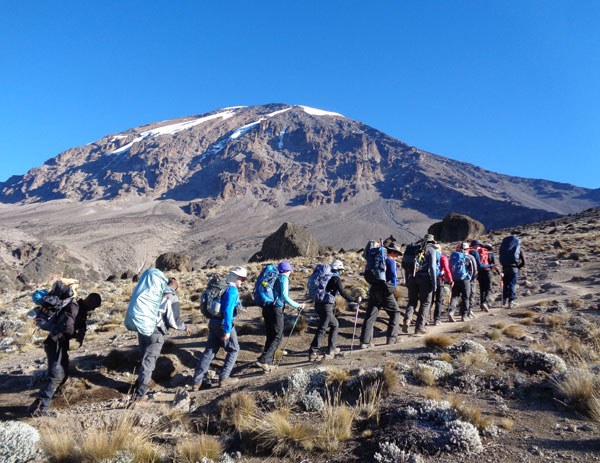
Wake up early at Mti Mkubwa camp and, after breakfast, you climb an hour or so to the top of the forest and then the trail gradually steepens and enters the giant heather moorland zone. Several streams are crossed. A gentle walk across the plateau leads to Shira 2-camp on moorland meadows next to a stream (3840m). By now you will be able to see, in an easterly direction, the Western Breach with its stunning glaciers. The porters will boil drinking and washing water, before serving dinner. The night at this exposed camp will even be colder than the previous night, with temperatures dropping to well below freezing. Enjoy dinner and overnight.
Hiking time: 7 Hours
The route now turns east into a semi desert and rocky landscape surrounding Lava Tower, where you reach an altitude of 4630m after about a 5 hours walk. Lunch is served in a designated area before ascending the rocky scree path to Lava Tower (4630m). Definitely the toughest day so far. It is normally around this point, where for the first time, some climbers will start to feel symptoms of breathlessness, irritability and headaches.
After lunch you descent again by almost 680m to the Barranco camping area and after reaching the high altitude of 4600m at Lava Tower, the true acclimatization benefit of this day becomes clear. This descent to Barranco camp takes about 2 hours and offers great opportunities to take some beautiful photographs of the Western Breach and Breach Wall. The camp is situated in a valley below the Breach and Great Barranco Wall, which should provide you with a memorable sunset while you wait for your dinner.
Hiking time: 7 hours
Habitat: Alpine Desert.
After spending a night at the Great Barranco Wall, you make your way up this awesome looking obstacle, which in the end normally turns out to be easier than anticipated. Topping out just below the Heim Glacier, you now appreciate just how beautiful Kilimanjaro really is. The route then heads down through the Karanga Valley over intervening ridges and valleys, and then joins up with the Mweka route.
This is the preferred route down from the summit, so remember it. Turn left up the ridge and after another hour or so, you reach Barafu Hut. The last water stop on the route is the Karanga Valley, as there is no water at Barafu camp. Barafu is the Swahili word for “ice” and it is a bleak and inhospitable camping area to spend the night.
Totally exposed to the ever-present gales the tents are pitched on a narrow, stony, and dangerous ridge. Make sure that you familiarize yourself with the terrain before dark to avoid any accidents. The summit is now a further 1345m up and you will make the final ascent the same night. Prepare your equipment, ski stick and thermal clothing for your summit attempt. This should include the replacement of your headlamp and camera batteries and make sure you have a spare set available as well. To prevent freezing it will be wise to carry your water in a thermal flask. Go to bed at round about 19h00 and try to get some precious rest and sleep
Hiking time: 8 hours to reach Uhuru Peak: 7/8 hours to descend to Mweka.
Distance: about 7kms ascent – 23kms descent
Habitat: Stone scree and ice-capped Summit.
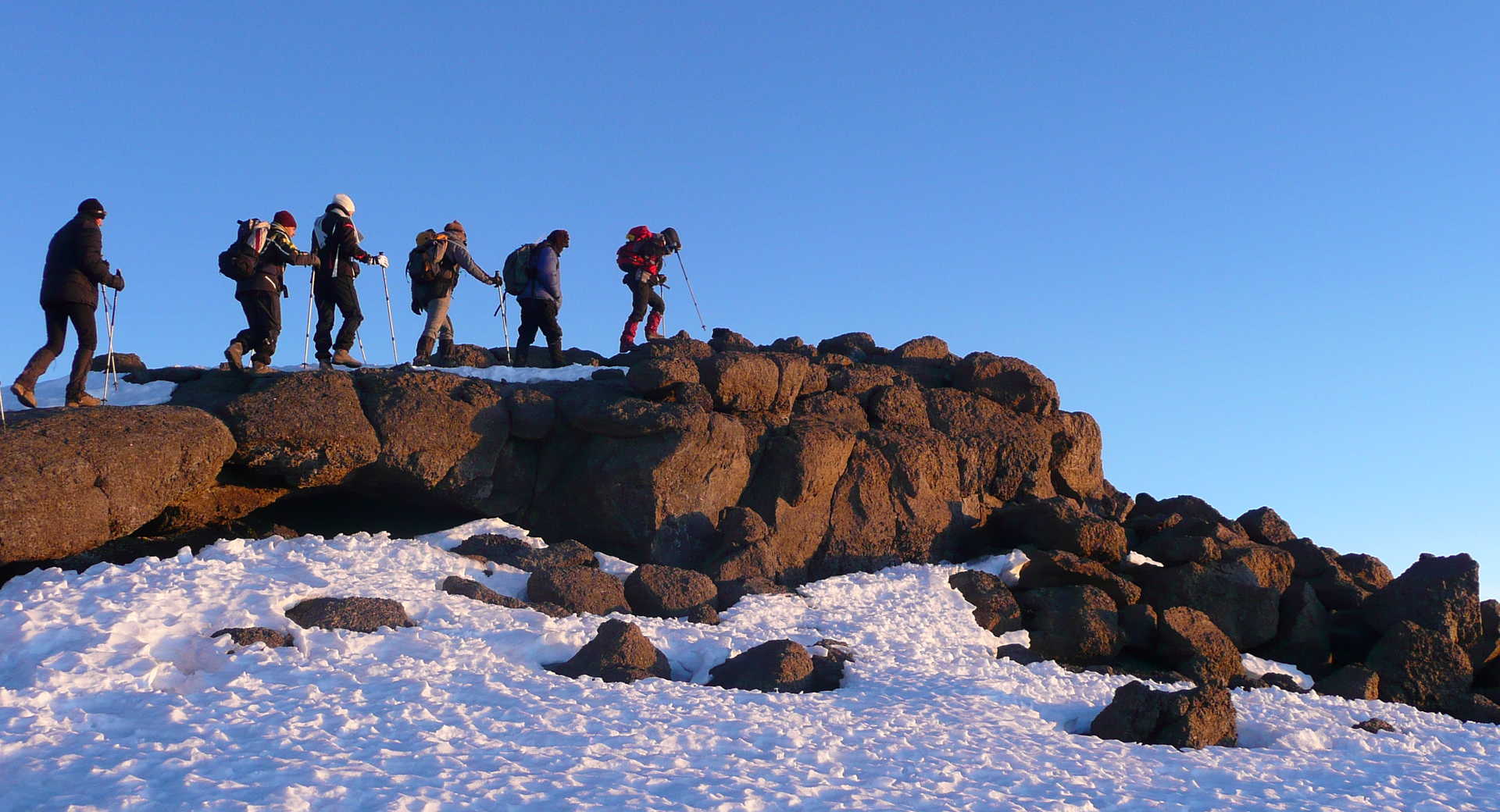
Wake up at midnight, and after some tea and biscuits you shuffle off into the night. You will head in a northwesterly direction and ascend through heavy scree towards Stella Point on the crater rim. This 6-hour walk to Stella point is for many climbers, mentally and physically the most challenging on the route. At Stella Point (5685m) you will stop for a short rest and will be rewarded with the most magnificent sunrise you are ever likely to see (weather permitting). From Stella Point you will normally encounter snow all the way on your 2-hour ascent to Uhuru Peak. The time you will spend on the summit will depend on the weather conditions.
Do not stop here for too long, as it will be extremely difficult to start again due to cold and fatigue. Enjoy your accomplishment and a day to remember for the rest of your live. The walk back to Barafu from the summit, takes about 3 hours. Here you will have a well earned but short rest and collect the rest of your gear, before heading down to Mweka hut (3100m). The route is not difficult and will take you down the rock and scree path into the moorland and eventually into the forest. The camp is situated in the upper forest and mist or rain can be expected in the late afternoon. Dinner and washing water will be prepared as well as drinking water.
Descending time: 3 hours
Habitat: Forest.
After an early and well-deserved breakfast, it is a short 3-hour and scenic hike back to the Park gate. At Mweka gate you sign your name and details in a register. This is also where successful climbers receive their summit certificates. Those climbers who reached Stella Point (5685m) are issued with green certificates and those who reached Uhuru Peak (5895m) receive gold certificates. From the Mweka Gate you will continue down into the Mweka village, where you will be served a delicious hot lunch!! You now drive back to Arusha for a dinner, overnight and celebrations!! Overnight in Arusha
Edit Content
Included
- Park entry fees (non-residents)
- Private 4x4 safari Land Cruiser with pop up roof
- Professional English speaking safari guide
- All game drives as per itinerary
- Accommodation as stated in the program
- All meals during safari (Breakfast, Lunch & Dinner)
- Drinking water during game drives
- Airport pick up and drop off (Kilimanjaro/Arusha)
- Government taxes and VAT
Excluded
- International flights
- Tanzania visa fees
- Travel and medical insurance
- Tips for guide and crew
- Personal expenses (souvenirs, drinks, laundry)
- Optional activities (balloon safari, Maasai village visit if extra)
- Extra accommodation before or after safari
- Government park fee increases if any
Quick Enquiry
You May Also Like
Get in touch

BMC TOURS & SAFARIS
Address
P O Box 10695, Arusha, Tanzania
Phone
+255 754 47 44 77 +255 739 47 44 77
info@bmctours-safaris.co.tz gm@bmctours-safaris.co.tz
Address
P O Box 10695, Arusha, Tanzania
info@bmctours-safaris.co.tz gm@bmctours-safaris.co.tz
Phone
+255 754 47 44 77 +255 739 47 44 77
Our dedicated team of staff has strong foreign-language capabilities and the experience to be sensitive to cultural differences.
Quick Link
We Accept


© 2026 bmc tours & safaris
